• Skip to primary navigation
  • Skip to main content

frankdenneman.nl

  • AI/ML
  • NUMA
  • About Me
  • Privacy Policy

Why is vMotion using the management network instead of the vMotion network?

February 7, 2013 by frankdenneman

On the community forums, I’ve seen some questions about the use of the management network by vMotion operations. The two most common scenarios are explained, please let me know if you notice this behavior in other scenarios.

Scenario 1: Cross host and non-shared datastore migration
vSphere 5.1 provides the ability to migrate a virtual machine between hosts and non-shared datastores simultaneously. If the virtual machine is stored on a local or non-shared datastore vMotion is using the vMotion network to transfer the data to the destination datastore. When monitoring the VMkernel NICs, some traffic can be seen following over the management NIC instead of the VMkernel NIC enabled for vMotion.
When migrating a virtual machine, vMotion determines hot data and cold data. Virtual disks or snapshots that are actively used are considered hot data, while the cold data are the underlying snapshots and base disk. Let’s use a virtual machine with 5 snapshots as an example. The active data is the recent snapshot, this is sent over across the vMotion network while the base disk and the 4 older snapshots are migrated via a network file copy operation across the first VMkernel NIC (vmk0).

The reason why vMotion uses separate networks is that the vMotion network is reserved for data migration of performance-related content. If the vMotion network is used for network file copies of cold data, it could saturate the network with non-performance related content and thereby starving traffic that is dependent on bandwidth. Please remember that everything sent over the vMotion network directly affects the performance of the migrating virtual machine.

During a vMotion the VMkernel mirrors the active I/O between the source and the destination host. If vMotion would pump the entire disk hierarchy across the vMotion network it would steal bandwidth from the I/O mirror process and this will hurt the performance of the virtual machine.
If the virtual machine does not contain any snapshots, the VMDK is considered active and it is migrated across the vMotion network. The files in the VMDK directory are copied across the network of the first VMkernel NIC.

Scenario 2: Management network and vMotion network sharing same IP-range/subnet
If the management network (actually the first VMkernel NIC) and the vMotion network share the same subnet (same IP-range) vMotion sends traffic across the network attached to first VMkernel NIC. It does not matter if you create a vMotion network on a different standard switch or distributed switch or assign different NICs to it, vMotion will default to the first VMkernel NIC if same IP-range/subnet is detected.
Please be aware that this behavior is only applicable to traffic that is sent by the source host. The destination host receives incoming vMotion traffic on the vMotion network!

I’ve been conducting an online-poll and more than 95% of the respondents are using a dedicated IP-range for the vMotion traffic. Nevertheless, I would like to remind you that it’s recommended to use a separate network for vMotion. The management network is considered to be an unsecured network and therefore vMotion traffic should not be using this network. You might see this behavior in POC environments where you use a single IP-range for virtual infrastructure management traffic.

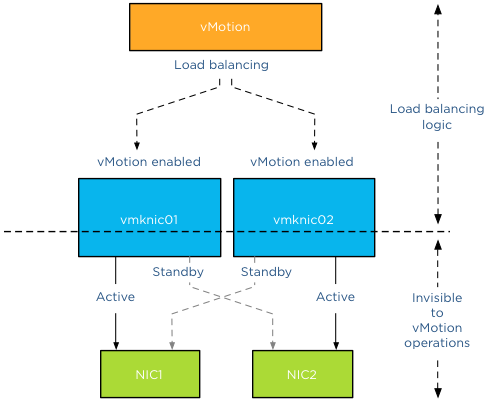
If the host is configured with a Multi-NIC vMotion configuration using the same subnet as the management network/1st VMkernel NIC, then vMotion respects the vMotion configuration and only sends traffic through the vMotion-enabled VMkernel NICs.

If you have an environment that is using a single IP-range for the management network and the vMotion network, I would recommend creating a Multi-NIC vMotion configuration. If you have a limited amount of NICs, you can assign the same NIC to both VMkernel NICs, although you do not leverage the load balancing functionality, you force the VMkernel to use the vMotion-enabled networks exclusively.

Filed Under: vMotion

Please help VMware bring project NEE down to its (k)nees

February 5, 2013 by frankdenneman

Folks,
We have been testing the HOL platform for a few weeks using automated scripts and thought it would be great if we could do a real time stress test of our environment.
The goal of this test is to put a massive load on our infrastructure and see how fast we can get the service to crawl to its knees. We understand that this is not a very good scientific approach but think collecting real user data will help us prepare for massive loads like Partner Exchange and VMworld.
Currently we have close to 10,000 users in the Beta so we expect the application / infrastructure to keel over right after we start. We want to use this test as a way to learn what happens and where the smoke is coming from.
If you registered for the Beta and you do not have an account please check your inbox from email from admin projectnee.com to verify your account. If you have not registered its time to do so,…REGISTER FOR BETA
Here is what we need you to do:

  1. Take any lab on Thursday Feb 7th from 2:00 – 4:00 PM PST.
  2. Send us feedback (on this thread) on your experience.
  3. Include Lab Name, Description of Problem, Screen Shot.

Follow Project NEE on Twitter for latest Updates http://twitter.com/vmwarehol
Thanks for your support!
 

Filed Under: VMware

Storage DRS Initial placement workflow

February 5, 2013 by frankdenneman

Last week I received the question how exactly Storage DRS picks a datastore.

On a SDRS the initial placement of a vm is done on the weight calculated based on the storage free and IO. My question is: when I have a similar weight between all the datastore in the cluster, which datastore is choose for the initial placement?

Storage DRS takes the virtual machine configuration into account, the platform & user-defined constraints and the resource utilization of the datastores within the cluster. Let’s take a closer look at the Storage DRS initial placement workflow.
User-defined constraint
When selecting the datastore cluster as a storage destination, the default datastore cluster affinity rule is applied to the virtual machine configuration. The datastore cluster can be configured with a VMDK affinity rule (Keep files together) or a VMDK anti-affinity rule (Keep files separated). Storage DRS obeys the affinity rule and is forced to find a datastore that is big enough to store the entire virtual machine or the individual VMDK files. The affinity rule is considered to be a user-defined constraint.
Platform constraint
The next step in the process is to present a list of valid datastores to the Storage DRS initial placement algorithm. The Storage DRS placement engine checks for platform constraints.
The first platform constraint is the check of the connectivity state of the datastores. Fully connected datastores (datastores connected to all host in the compute cluster) are preferred over partially connected datastores (datastores that are not connected to all host in the cluster) due to the impact of mobility of the virtual machine in the compute cluster.
The second platform constraint is applicable to thin-provisioned LUNs. If the datastore exceeds the thin-provisioning threshold of 75 percent, the VASA provider (if installed) triggers the thin-provisioning alarm. In response to this alarm Storage DRS removes the datastores from the list of valid destination datastores, in order to prevent virtual machine placement on low-capacity datastores.
Resource utilization
After the constraint handling, Storage DRS sorts the valid datastores in order of combined resource utilization rate. The combined resource utilization rate consists of the space utilization and the I/O utilization of a datastore. The best-combined resource utilization rate is a datastore that has a high level of free capacity and Low I/O utilization. Storage DRS selects the datastore that has the best-combined utilization rate and attempts to place the virtual machine. If the virtual machine is configured with a VMDK anti-affinity rule, Storage DRS starts with placing the biggest VMDK first.

Filed Under: Storage DRS

How to setup Multi-NIC vMotion on a distributed vSwitch

February 1, 2013 by frankdenneman

This article provides you an overview of the steps required to setup a Multi-NIC vMotion configuration on an existing distributed Switch with the vSphere 5.1 web client. This article is created to act as reference material for the designing your vMotion network series.
Configuring Multi-NIC vMotion is done at two layers, first the distributed switch layer where we are going to create two distributed port groups and the second layer is the host layer. At the host layer we are going to configure two VMkernel NICs and connect them to the appropriate distributed port group.
00-distributed-switch-and-host-levels
Before you start you need to have ready two ip-addresses for the VMkernel NICs, their respective subnet and their VLAN ID.
Distributed switch level
The first two steps are done at the distributed switch level, click on the networking icon in the home screen and select the distributed switch.
Step 1: Create the vMotion distributed port groups on the distributed switch
The initial configuration is pretty much basic, just provide a name and use the defaults:
 
1: Select the distributed switch, right click and select “New Distributed Port Group”.
01-New-Distributed-Port-Group
2: Provide a name, call it “vMotion-01” and confirm it’s the correct distributed switch.
02-Name-and-Location
3: Keep the defaults at Configure settings and click next.
03-dPortgroup-settings
4: Review the settings and click finish.
Do the same for the second distributed port group, name that vMotion-02
Step 2: Configuring the vMotion distributed port groups
Configuring the vMotion distributed port groups consist of two changes. Enter the VLAN ID and set the correct failover order.
1: Select distributed Port Group vMotion-01 in the left side of your screen and right click and select edit settings.
2: Go to VLAN, select VLAN as VLAN type and enter the first VLAN used by the first VMkernel NIC.
04-VLAN-ID
3: Select “Teaming and failover” , move the second dvUplink down to mark it as a “Standby uplink”. Verify that load balancing is set to “Route based on originating virtual port”.
05-teaming-and-failover
4: Click OK
Repeat the instructions of step 2 for distributed Portgroup vMotion-02, but use the VLAN ID used by the IP-address of the second VMkernel NIC.
06-VLAN-ID-2
Go to teaming and failover and configure the uplinks in an alternate order, ensuring that the second vMotion VMkernel NIC is using dvUplink2.
07-teaming-and-failover
Host level
We are done at the distributed switch level, the distributed switch now updates all connected hosts and each host has access to the distributed port groups. Two vMotion enabled VMkernel NICs are configured at host level. Go to Hosts and Clusters view.
Step 3: Create vMotion enabled VMkernel NICs
1: Select the first host in the cluster, go to manage, networking and “add host networking”.
08-add-host-networking
2: Select VMkernel Network Adapter.
09-VMkernel-Network-Adapter
3: Select an existing distributed portgroup, click on Browse and select distributed Port Group “vMotion-01” Click on OK and click on Next.
10-select-network
11-select-target-device
4: Select vMotion traffic and click on Next.
12-Port-Properties
5: Select static IPv4 settings, Enter the IP-address of the first VMkernel NIC corresponding with the VLAN ID set on distributed Port Group vMotion-01.
13-ip-address
6: Click on next and review the settings.
Create the second vMotion enabled VMkernel NIC. Configure identically except:
1: Select vMotion-02 portgroup
2: Enter IP-address corresponding with the VLAN ID on distributed Port Group vMotion-02.
The setup of a Multi-NiC vMotion configuration on a single host is complete. Repeat Step 3 on each host in the cluster.

Filed Under: Networking, vMotion

10 guidelines for creating good looking diagrams

February 1, 2013 by frankdenneman

Frequently I receive the question which application I use to create my diagrams. I used to use Microsoft Visio but starting to use Omnigraffle a year ago. However I feel it’s not the program that makes these diagrams. Although it’s true that some functionality help me to create the diagrams more easily, it’s more about following some basic guidelines. I’ve picked up these guidelines along the way, they work for me and hopefully they can help you too.
1: Find a suitable color scheme
A color scheme plays a very important role in a diagram. Colors have various functions within a diagram. I like to use various tints of a color to indicate a relation between objects, whether it has to indicate a relation within the same structure layer or the same consumer or provider. For example all storage related functions or objects have different shades of blue or resource pool structure of customer A have different shades of green.
Picking the correct color for a diagram is very difficult and trying to select the perfect collection of colors wasted (I should say invested) many hours of my life. During that time I learned a lot, here are a few tips:

  • Use a color scheme that provides contrast between different objects.
  • Use the wheel of color to easily select complimentary colors (Colors on opposite sides of the color wheels). I prefer using multiple triad (3-point) complement color schemes.
  • When using multiple triads, uses colors of similar saturation levels. Saturation refers how a “color” appears under a particular lighting condition. Mixing primary and secondary colors with similar saturation levels provides a more cohesive looking design. For example, a bright red color mixed with a blue-ish green color can give some strange effects, sometimes giving the illusion of vibrating when not looking directly at them (very annoying).
  • Use a limited set of colors, don’t allow your diagram to become the poster-child for circus publication guidelines.

Resources:

  • Smashing magazine have published an excellent series on color theory
  • colorschemedesiginer.com shows the Color wheel, use the triad function

2: Fonts
Besides legibility and readability a proper font (typeface) makes the diagram “look right”. Objects and fonts are interrelated when it comes to conveying a subject. Both the font type and the objects in the diagram translate and visualize an idea or concept. Colors evoke feelings and moods, while the font determine the tone of voice in which the message is broadcasted.
Two major categories of typefaces can be identified in the world of fonts. Serif and sans-serif. Serif fonts can be recognized by having small lines at the end of the strokes of a letter. Times new roman is a good example of a serif font. Serif fonts mimic handwriting and can provide a outdated but also formal feeling. Sans-serif fonts lack the small lines and provide a much cleaner and modern look. I have seen diagrams illustrating technologies and features that weren’t released yet, but still gave me an outdated, well-worn feeling. Try use sans-serif fonts when creating computer technology related diagrams.

  • Use a sans-serif font (PT sans or corbel are excellent choices)
  • Try to use a font that compliments the font used in the articles
  • Use a single font in a diagram; use different font weights (light, medium, bold) to emphasize.
  • Color contrast; use dark colors on white background, white on black background. Tip: dark blue on white gives a rich feeling to the labels.
  • Use handwritten fonts only if you use hand drawn objects. Match font style with objects. Swooping lines as connectors allow for the use of a more elegant font, however keep it in style with your overall blog theme and used fonts.
  • Do not use Comic sans, unless you are diagramming your lemonade stand!

Resources:

  • Google fonts and myfonts.com provide an enormous font collection. Most of them can be downloaded for free.
  • Use whatthefont service to identify a specific font used in an image.


3: Lines
Lines come in all shapes and forms. Try to be consistent with the types of lines you use. If you use a dashed line for indicating standby functionality, do not use the same line pattern for an active connection. Think about the thickness of the lines used. If you selected a very clean lightweight font, don’t use thick lines for the framework of boxes and other objects. Mix and match line weight with font weight. Strive for balance across the entire diagram.
4: Whitespace
Whitespace or often revered to as negative space is the portion of the diagram left unused. It’s the space between the objects and this is what I believe actually the most important thing to get right. The balance between the positive (objects) and the negative (whitespace) is fundamental to create an aesthetic pleasing diagram. Whitespace can help to emphasize particular elements but also help to balance the objects in the diagram. Using too much whitespace and a relationship between two objects may get lost.

5: Align!
Always align objects horizontally and if applicable vertically. These details matter. It might not be easily identified by eye, but your subconscious picks it up and alerts you “something is not right”. Most people tend to shy away and that’s conflicts the first reason why you made the diagram. To help people better understand the subject by creating additional visual aids. Omnigraffle is far more advanced than Visio when it comes to auto alignment. Omnigraffle provides automatic guides displaying the white space between objects in the same line. That feature saved me many hours
6: Go minimal
Try to reduce the number of objects as much as possible. Get to the essence of the subject as much as possible. IT people like to put in as much as detail as possible. If these objects are not relevant to the subject you are trying to depict, leave them out. This increases the focus point of the diagram. Going minimal is harder than it sounds. By using as little objects as possible you spend a lot time focusing on spacing, positioning, typography and contrast.
7: Shadows
The novelty of shadows beneath lines and boxes wear off quickly. After viewing the diagram a couple of times, the shadows give the diagram an unclean and grimy feeling. It doesn’t look clean, fresh and rapidly feels outdated after seeing the diagram a couple of times. My advice: Try to avoid it as much as possible.
8: Real men make block diagrams
Sometimes I jokily reply this when somebody is asking for vendor stencils and icon-packs on twitter. Vendor stencils can be very useful for some types of diagrams, for example wiring diagram of a core Ethernet switch. I prefer to stay away from using pre-made icons in diagrams indicating architecture or relationships. Pre made icons come in their own color scheme and are usually in an isometric perspective to give that 3d feel. Forcing you to design the whole diagram in an isometric perspective. Certain Icon designs distract the viewer, reducing the ability of the diagram to convey the message. By creating your own objects, you can choose your own color scheme, your own level of detail, and your own direction of perspective.
9: Commit to a single perspective
Already mentioned in the number 8, when using an icon in isometric perspective commit to drawing in an isometric perspective. The viewpoint of an isometric diagram is slightly rotated to reveal other surfaces than those visible from a top-down perspective. Isometric diagrams are a great way for illustrating all the physical components of (virtual) architectures. A while ago I stumbled upon an old isometric diagram I created for a client of mine. Mixing isometric icons with top-down icons provides an unbalanced view. Usually the lines do not connect well or are just to complete parallel or horizontally aligned, providing hours of frustration to the stickler for details.
Isometric diagram of virtual infrastructure
10: Relevance
A picture is worth a thousand words, but don’t draw a giraffe after you wrote three paragraphs about the feeding habits of elephants. This is an extreme example, but use a diagram to help the reader to understand the aspect of the topic and assist him with the identification of the subject. Don’t allow a diagram to confuse your audience. I’ve seen countless diagrams in VCDX architecture designs of arrays connected to an FC architecture, when the candidate was using an iSCSI. If you use 6 LUNs, don’t use a diagram that shows an object with the words “LUN 1 …. LUN 99” in it. Allow the diagram relay information to strengthen the written word.
Be consistent and have fun
In almost all of the other guidelines I provide examples why consistency is important. It helps the reader to identify components and their relation more easily. Especially when you use a series of diagrams in the same presentation or publication. Do it well and allow it to become your trademark. But most of all have fun while creating diagrams. It shows!

Filed Under: Miscellaneous

  • « Go to Previous Page
  • Page 1
  • Interim pages omitted …
  • Page 47
  • Page 48
  • Page 49
  • Page 50
  • Page 51
  • Interim pages omitted …
  • Page 89
  • Go to Next Page »

Copyright © 2026 · SquareOne Theme on Genesis Framework · WordPress · Log in