In vSphere 5.1 you can configure the default (anti) affinity rule of the datastore cluster via the user interface. Please note that this feature is only available via the web client. The vSphere client does not contain this option.
By default the Storage DRS applies an intra-VM vmdk affinity rule, forcing Storage DRS to place all the files and vmdk files of a virtual machine on a single datastore. By deselecting the option “Keep VMDKs together by default” the opposite becomes true and an Intra-VM anti-affinity rule is applied. This forces Storage DRS to place the VM files and each VDMK file on a separate datastore.
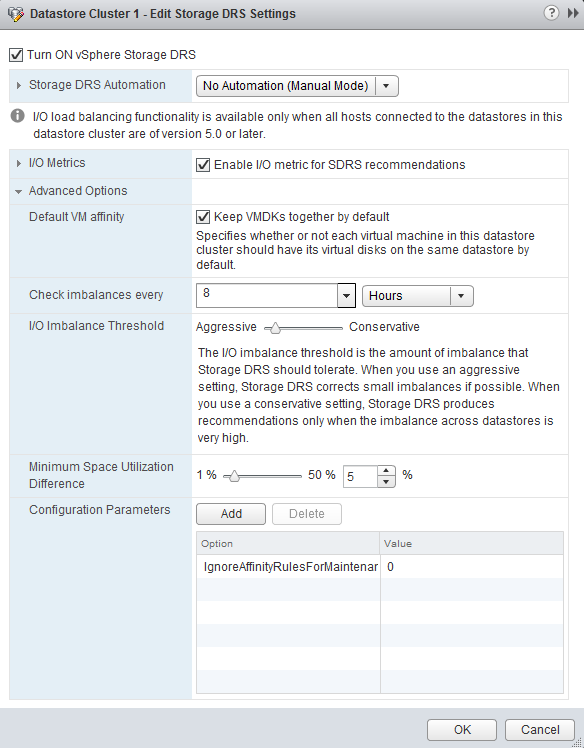
Please read the article: “Impact of intra-vm affinity rules on storage DRS” to understand the impact of both types of rules on load balancing.
vSphere 5.1 storage vMotion parallel disk migrations
Where previous versions of vSphere copied disks serially, vSphere 5.1 allows up to 4 parallel disk copies per Storage vMotion operation When you migrate a virtual machine with five VMDK files, Storage vMotion copies of the first four disks in parallel, then starts the next disk copy as soon as one of the first four finishes.
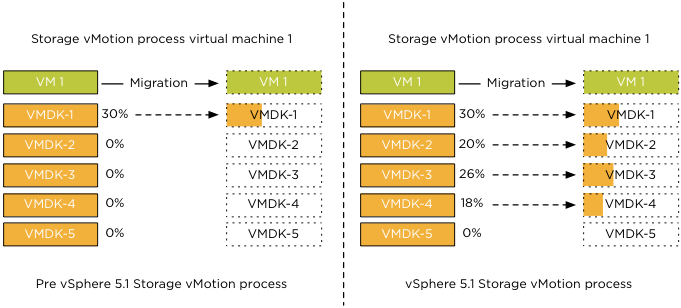
To reduce performance impact on other virtual machines sharing the datastores, parallel disk copies only apply to disk copies between distinct datastores. This means that if a virtual machine has multiple VMDK files on Datastore1 and Datastore2, parallel disk copies will only happen if destination datastores are Datastore3 and Datastore4.
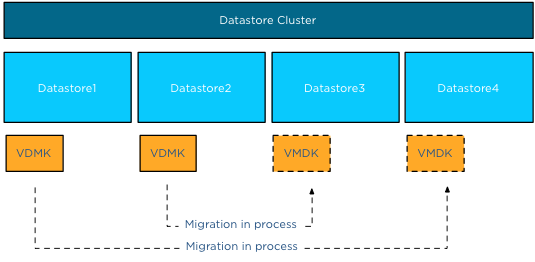
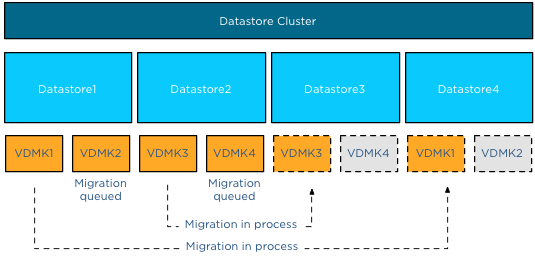
Let’s use an example to clarify the process. Virtual machine VM1 has four vmdk files. VMDK1 and VMDK2 are on Datastore1, VMDK3 and VMDK4 are on Datastore2. The VMDK files are moved from Datastore1 to Datastore4 and from Datastore2 to Datastore3. VMDK1 and VMDK3 are migrated in parallel, while VMDK2 and VMDK4 are queued. The migration process of VMDK2 is started the moment the migration of VMDK1 is complete, similar for VMDK4 as it will be started when the migration of VMDK3 is complete.
A fan out disk copy, in other words copying two VMDK files on datastore A to datastores B and C, will not have parallel disk copies. The common use case of parallel disk copies is the migration of a virtual machine configured with an anti-affinity rule inside a datastore cluster.
Storage DRS datastore correlation detector
One of the cool new features of Storage DRS in vSphere 5.1 is the datastore correlation detector used by the SIOC injector. Storage arrays have many ways to configure datastores from among the available physical disk and controller resources in the array. Some arrays allow sharing of back-end disks and RAID groups across multiple datastores. When two datastores share backend resources, their performance characteristics are tied together: when one datastore experiences high latency, the other datastore will also experience similar high latency since IOs from both datastore are being serviced by the same disks. These datastores are considered “performance-related”. I/O load balancing operations in vSphere 5.1 avoid recommending migration of virtual machines between two performance-correlated datastores.
I/O load balancing algorithm
Storage DRS collects several virtual machine metrics to analyze the workload generated by the virtual machines within the datastore cluster. These metrics are aggregated in a workload model. To effectively distribute the different load of the virtual machines across the datastores, Storage DRS needs to understand the performance (latency) of each datastore. When a datastore violates its I/O load threshold, Storage DRS moves virtual machines out of the datastore. By linking workload models to device models, Storage DRS is able to select a datastore with a low I/O load when placing a virtual machine with a high I/O load during load balance operations.
Performance related datastores
However if data is moved between datastores that are backed by the same disks, the move may not decrease the latency experienced on the source datastore as the same set of disks, spindles or RAID-groups service the destination datastore as well. I/O load balancing recommendations should avoid using two performance-correlated datastores, since moving a virtual machine from the source datastore to the destination datastore has no effect on the datastore latency. How does Storage DRS discover performance related datastores?
How does it work? The datastore correlation detector measures performance during isolation and when concurrent IOs are pushed to multiple datastores. The basic mechanism of correlation detector is rather straightforward: compare the overall latency when two datastores are being used alone in isolation and when there are concurrent IO streams on both of the datastores. If there is no performance correlation, the concurrent IO to the other datastore should have no effect. Contrariwise, if two datastores are performance correlated, then concurrent IO stream should amplify the average IO latency on both datastores. Please note that datastores will be checked for correlation on a regular basis. This allows Storage DRS to detect changes to the underlying storage configuration.
Example scenario
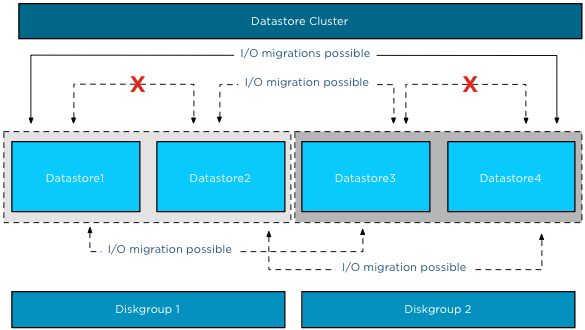
In this scenario Datastore1 and Datastore2 are backed by disk devices grouped in Diskgroup1, while Datastore3 and Datastore4 are backed by disk devices grouped in Diskgroup2. All four datastores belong to a single datastore cluster.
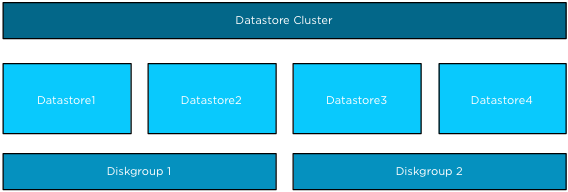
After SIOC has run the workload and device models on a datastore, SIOC picks a random datastore in the datastore cluster to check for correlations. If both datastores are idle, the datastore correlation detector uses the same workload to measure the average I/O latency in isolation and concurrent I/O mode.
Isolation
The SIOC injector measures the average IO latency of Datastore1 in isolation. This means it measures the latency of the outstanding I/O of Datastore1 alone. Next, it measures the average IO latency of Datastore2 in isolation.
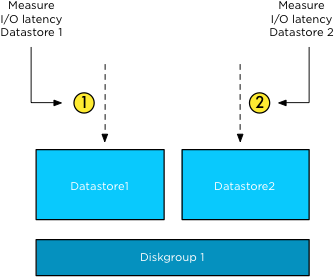
Concurrent I/Os
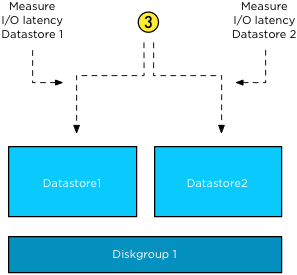
The first two steps are used to establish the baseline for each datastore. In the third step the SIOC injector sends concurrent I/O to both datastores simultaneously.
This results in the behavior that Storage DRS does not recommend any I/O load balancing operations between Datastore1 and 2 and Datastore3 and 4, but it can recommend for example to move virtual machines from Datastore1 to Datastore2 or from Datastore2 to Datastore3, etc. All moves are possible as long as the datastores are not correlated.
Enable Storage DRS on performance-correlated datastores?
When two datastores are marked as performance-correlated, Storage DRS does not generate IO load balancing recommendations between those two datastores. However Storage DRS can be used for initial placement and still generate recommendations to move virtual machines between two correlated datastores to address out of space situations or to correct rule violations. Please keep in mind that some arrays use a subset of disk out of a larger diskpool to back a single datastore. With these configurations, it appears that all disks in a diskpool back all the datastores but in reality they don’t. Therefor I recommend to set Storage DRS automation mode to manual and review the migration recommendations to understand if all datastores within the diskpool are performance-correlated.
vSphere 5.1 Clustering Deepdive available
Duncan and I released the vSphere 5.1 Clustering deepdive book this week. The book contains the new features of the vSphere 5.1 suite. We rewrote the Storage DRS chapter and have added a complete new chapter focusing on Stretched Clusters.
Font changes
The challenge for us was to include all the new content in the book without allowing the book to grow beyond its trademark dimensions. To achieve this we used a different font and decreased the font size, this resulted in a growth of 80 pages, making it 415 pages instead of the 505 pages if we used the previous font. Please note that although we decreased the font size, this did not decrease the legibility of the book.
Special cover
The cover is designed in such a way that you can actually have multiple copies with all different shades of orange, dare I say 50 shades of Orange. 😉
We hope you enjoy the new version of the vSphere clustering deepdive series. It’s available in Paperback and Kindle format.
Paper copy – $ 24.95
Kindle version – $ 7.49
CloudPhysics in a nutshell
Disclaimer: I’m a technical advisor for CloudPhysics.
I’m very happy to see CloudPhysics coming out of stealth mode this week and making their beta product available to the public. In a nutshell CloudPhysics is bringing Big Data analytics to the IT environment and it will provide you with tools to analyze your datacenter. How does it acquire this dataset and what benefit do you get from it?
The Observer Appliance
To gather all that data, an Observer Appliance needs to run in the virtual infrastructure. And in order to get a valuable dataset that is used for analytics and simulations the Observer needs to be active in as many as virtual infrastructures as possible. Running an appliance that sends operational data to a third party like CloudPhysics can be a security concern. Going into detail about how CloudPhysics designed the system to handle privacy, security and data sharing issues is outside the scope of this article. In short, data extracted from the virtual infrastructure are performance statistics and inventory and configuration settings. All environmental details are scrubbed and no log files or content of disk and memory is gathered.
The User Interface
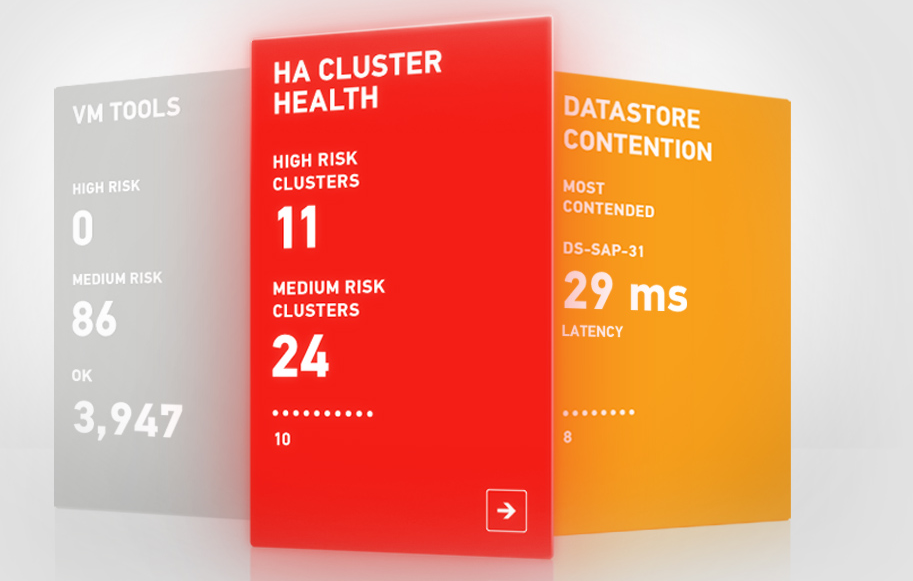
The data acquired by the Observer Appliance is accessible at https://app.cloudphysics.com. Logging in will give you access to your own data. The beta product provides a user interface that allows you to dive into specific focus areas. The UI provides so-called cards that displays key data points and is a launch point to a more detailed view. This view can contain information about the relationship with other features of the vSphere stack. An example of such a card would be Virtual Machine level reservations. Not only does this card provide you information about the present virtual machine level reservations in your environment in a clear and concise manner, it also displays the impact the reservation has on the High Availability slot size and therefor the consolidation ratio of your cluster. All this information combined in a single screen, no need to navigate through multiple screens and correlate particular metrics.
Correlation of metrics
Correlation of particular settings and understanding the impact each setting has on a complex environment, such as a virtual infrastructure, is time consuming and above all very difficult. This correlation of metrics allows you to save time, but it also helps you understand behavior of your environment. Now you might ask how do you know you can trust if these correlations are correct and this is one of the most interesting things about this product. It’s a combination of product expertise and community driven input.
The two pillars of knowledge
The CloudPhysics team comprises of industry heavy hitters. Some of these persons invented core features of the vSphere stack while working for VMware, while others made their mark at other industry leading companies. The second pillar is the community involvement. In this beta program, registered users can suggest ideas for utility cards. Domain experts will verify the community provided cards on technical accuracy.
Near-future developments
One thing I’m very exited about is the upcoming High Availability and DRS simulation tools. Both HA and DRS can be a challenge to configure as some settings impact the virtual infrastructure on multiple levels. The HA and DRS simulation analyzes current settings and provides you a platform where you can predict the effects of a change on your environment.
VMworld Challenge 2012
Now back to the current status. CloudPhysics is running a VMworld Challenge 2012. The contest allows you to describe the problems you are facing, such as “I’m applying different disk shares in my environment but I cannot see the worst case scenario allocation”. The more card you produce, the more points you score. To increase your score, download the Observer Appliance and take your environment for a test drive. The more activity you generate, the more points you accumulate. How will you benefit from this contest, first of all, if you are located in the U.S. you can win some great prices. (Due to U.S legislation, non-U.S. residents are excluded from winning prizes), but by submitting cards you improve the system and the quality of the reporting tool and simulation tool.
Resource Management as a Service
I started of with a disclaimer, I am a technical advisor to CloudPhysics and you can expect to see more articles about the development of CloudPhysics. As I’m able to work with the inventors of DRS and Storage DRS, a lot of my focus is on resource management. Together with the input of the community, the continuous analysis by domain experts you can expect that this might well turn out as Resource Management as a Service.